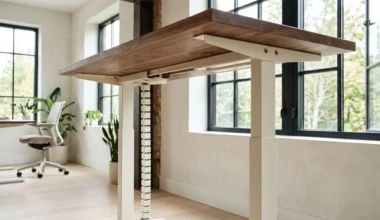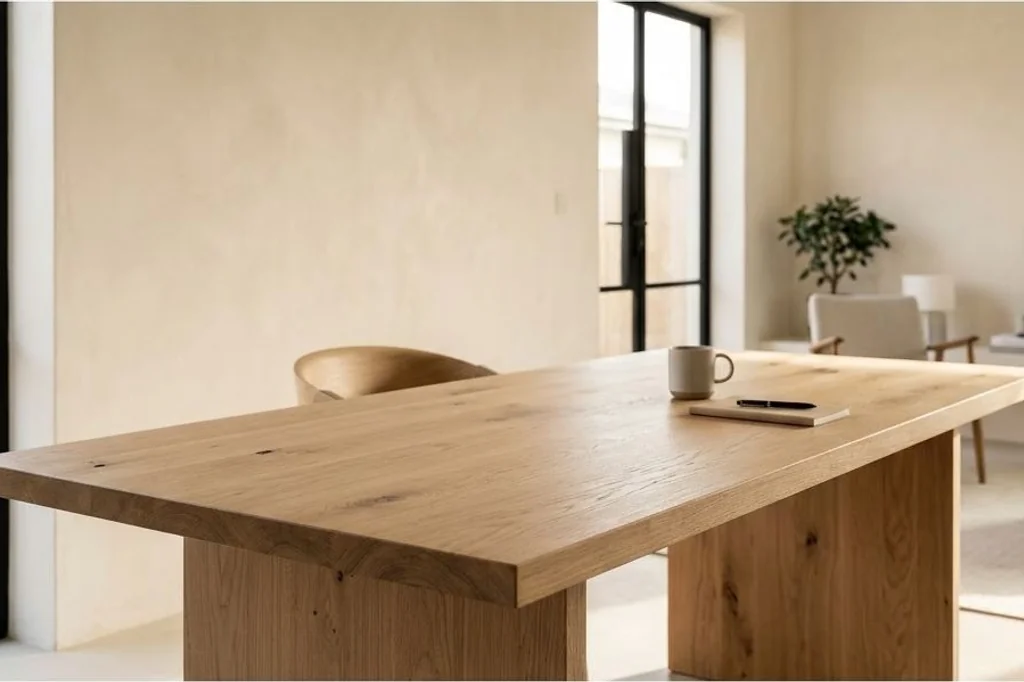
In contemporary residential architecture, the home office has evolved from an afterthought into a sanctuary of sustained focus and mental restoration. Knowledge workers spend eight to ten hours daily interacting with work surfaces. When that surface consists of synthetic laminate or pressed particle board, the sensory experience remains sterile and uninspiring. Introducing a solid timber desk top into a Scandinavian workspace establishes an organic anchor that grounds the entire room in tactile authenticity and biophilic warmth.
Scandinavian design philosophy has long revered timber not merely as an inert construction material, but as a living element that ages gracefully alongside its custodian. A solid hardwood slab reflects directional daylight with soft, diffused luminance, dampens acoustic reverberation from keyboard keystrokes, and develops a rich patina over decades of mindful use. To explore our broader design perspective on mindful interiors, browse the comprehensive articles on our Ornista workspace philosophy archive.
Key Takeaways
- White oak provides supreme surface hardness and pale Nordic warmth, making it the quintessential Scandinavian desk surface.
- American walnut introduces rich architectural contrast and fine grain, grounding airy open home office pavilions.
- European ash delivers remarkable tensile elasticity and dynamic cathedral grain patterns at approachable investment levels.
- Matte hardwax oil finishes preserve raw tactile wood pores while offering stain resistance against domestic liquids.
- Allowing forty-eight hours of room acclimatization prevents warping and seasonal dimensional cupping.
Evaluating White Oak, American Walnut, and European Ash
Selecting the right hardwood species requires balancing aesthetic tone, grain geometry, and mechanical density:
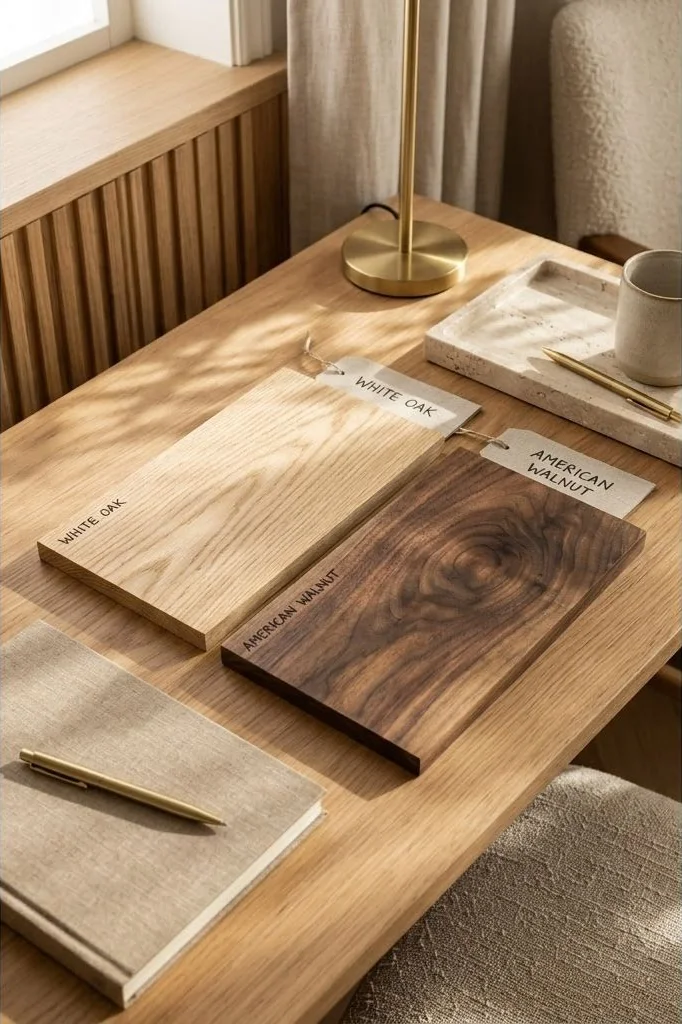
European White Oak serves as the benchmark timber of Scandinavian minimalism. Characterized by tight, linear medullary rays and muted wheat undertones, white oak harmonizes effortlessly with neutral lime-wash walls and brushed stainless steel accessories. Its Janka hardness rating of approximately 1,360 lbf ensures robust resilience against accidental drops and constant mouse movement.
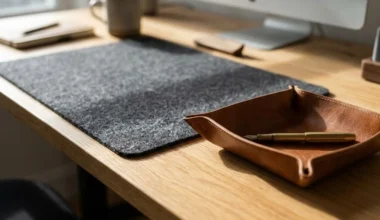
American Black Walnut introduces dramatic tonal gravity into bright, monochromatic rooms. Ranging from deep chocolate hues to warm mocha swirls, walnut softens sterile spaces and pairs elegantly with charcoal wool felt desk pads. Although slightly softer than oak at 1,010 lbf, walnut possesses superior dimensional stability and resists seasonal expansion across fluctuating indoor humidity levels.
European Ash represents an expressive alternative, renowned for bold cathedral grain arcs and pale cream tones with subtle olive heartwood streaks. Ash exhibits extraordinary tensile strength and shock resistance. When treated with a pigmented white oil, ash maintains an ethereal Nordic brightness that prevents rooms from feeling visually heavy.
Tactile Finishes: Hardwax Oils Versus Film Finishes
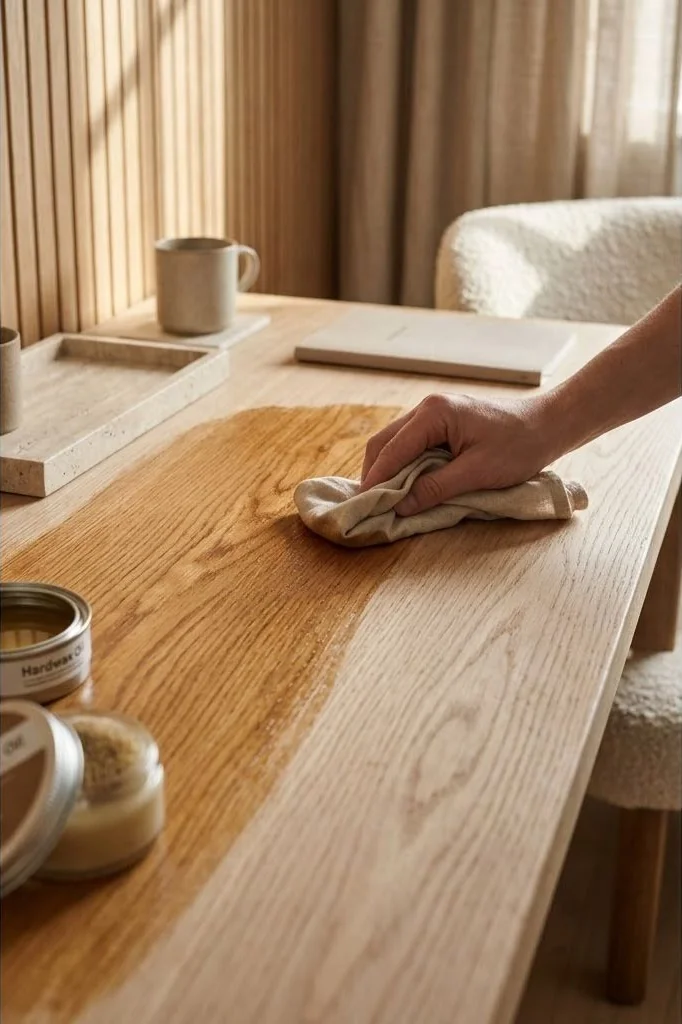
The finish applied to a solid timber desktop determines both its sensory appeal and maintenance ritual. Traditional commercial furniture frequently utilizes thick, solvent-based polyurethane coatings. While polyurethane creates an impermeable synthetic plastic barrier, it completely encases the wood pores, rendering the surface cold, slick, and prone to white micro-scratch hazing under task lamps.
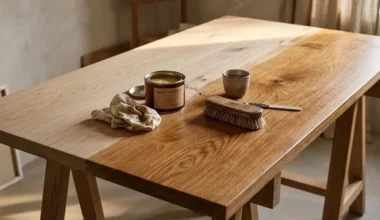
In contrast, Scandinavian craftsmen prioritize natural hardwax oils formulated from carnauba wax, beeswax, and vegetable oils. Hardwax oils soak directly into the upper cellular structure of the timber while allowing microscopic air exchange. The result is a velvety, ultra-matte sheen that feels warm and organic to resting forearms. For practical maintenance routines and spot-repair strategies, consult our comprehensive guide on solid wood desk maintenance care.
Desktop Proportions, Edge Profiles, and Spatial Balance
Spatial harmony in a minimalist home office relies heavily on proportional discipline. An oversized timber slab suffocates small study alcoves, while an undersized desk looks precarious beneath large architectural windows. For balanced functionality, a desktop depth of 30 inches and a width between 60 and 72 inches accommodates dual displays, studio monitors, and writing paper without spatial compression.
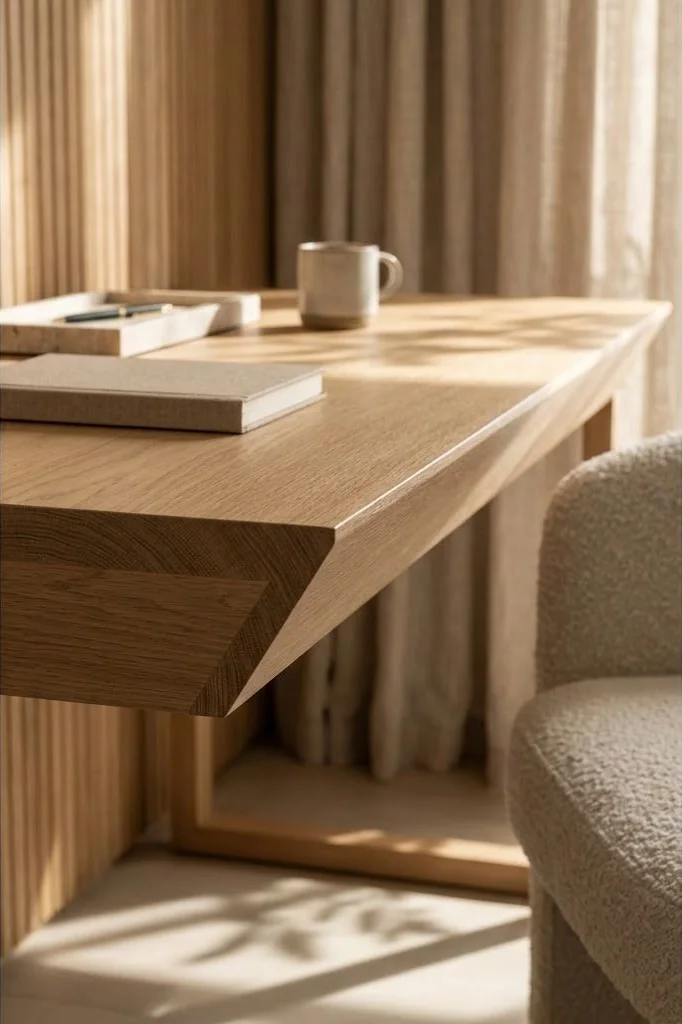
Edge profiles subtly influence the visual mass of the timber slab. A square edge with a subtle 2-millimeter chamfer celebrates rectilinear honesty, making thick slabs appear substantial and permanent. Alternatively, a reverse bevel edge – often termed an undercut or knife edge – visually tapers the outer perimeter, making a heavy 1.5-inch oak top appear to float weightlessly above slender steel support trestles.
Mitigating Seasonal Wood Movement and Warping
Solid hardwood is hygroscopic; it continuously absorbs and releases ambient moisture in response to indoor relative humidity. In winter, heated interior air causes wood to contract across its tangential grain, whereas humid summer air induces expansion. Ignoring this physical law leads to surface cupping, bowing, and cracked glue joints.
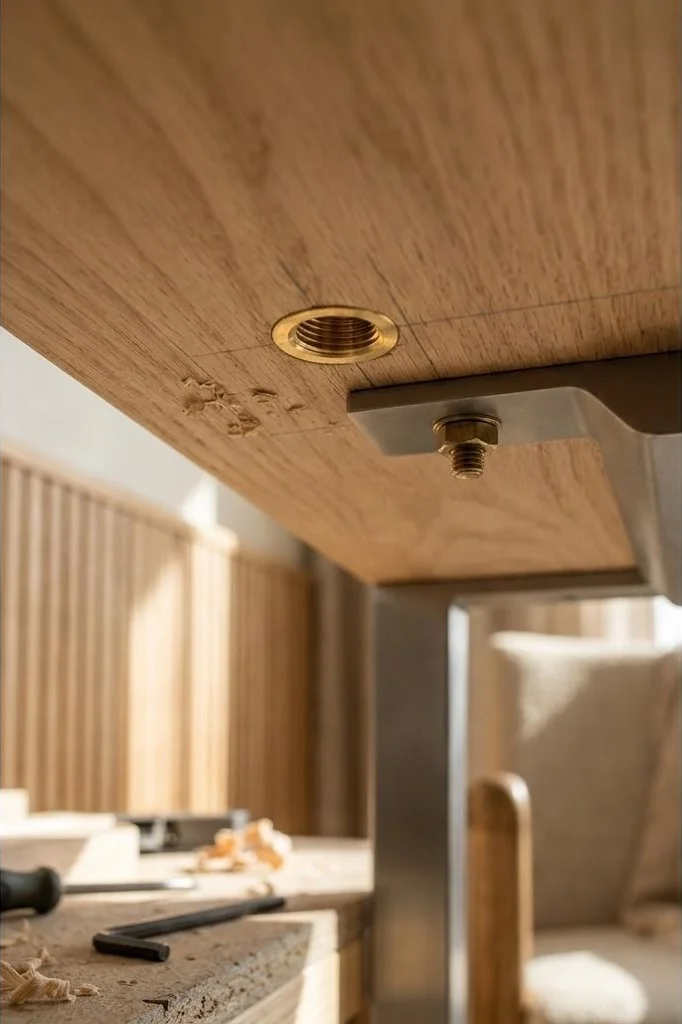
Preventing seasonal movement begins with slotted mounting points beneath the desk frame. Fasteners securing the steel frame to the wooden slab must be seated within oval slots, allowing the wood to expand and contract smoothly across its width without fighting rigid mechanical screws. Professional builders frequently embed threaded brass inserts into the underside of the top, providing durable mechanical connection points that withstand repeated disassembly.
Harmonizing Wood Tones With Desk Organizers
Once a solid timber desk top is anchored in the room, desktop accessories must be curated with intentional restraint. Placing cheap plastic pencil cups or brightly colored office supplies upon a finely oiled oak surface disrupts visual cohesion immediately. Instead, choose desk organizers that echo natural materials through contrasting textures.
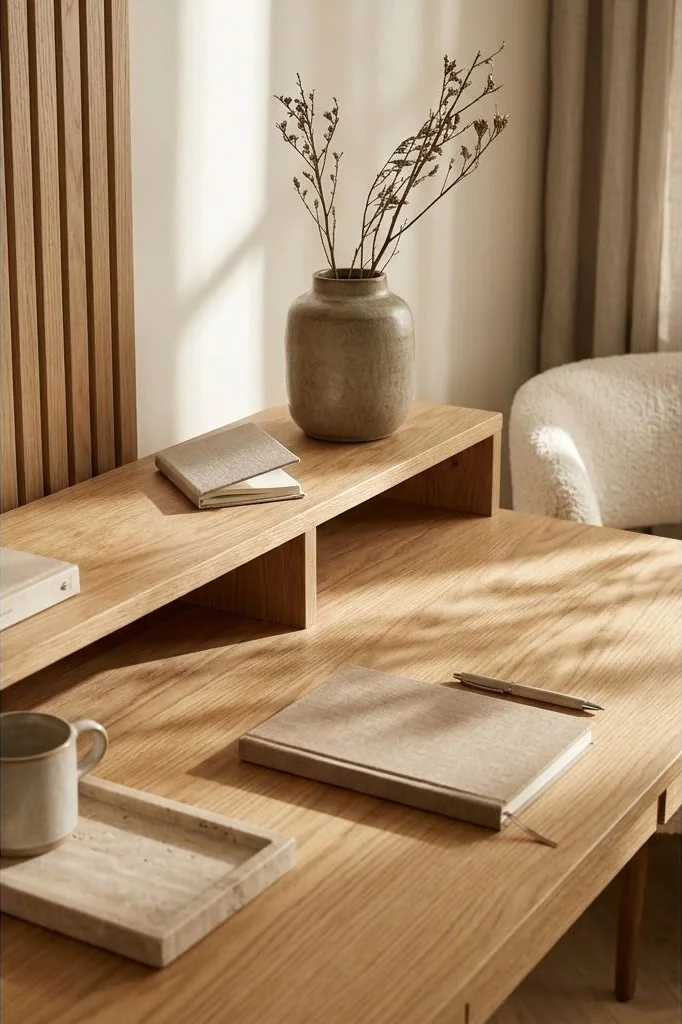
Introduce a solid wood monitor riser or desk shelf that either matches the desktop species exactly or contrasts intentionally with blackened timber. As detailed in our breakdown of Scandinavian desk shelf organization, a raised shelf creates a dedicated second tier that clears valuable lower work space. International architectural publications like Architectural Digest continually highlight that balancing raw materials with minimalist discipline fosters mental tranquility throughout demanding workdays.

Core Spatial Principles for Nordic Workspaces
To ensure your workspace layout retains its serene balance through evolving seasons and technology updates, anchor your setup around three timeless architectural guidelines:
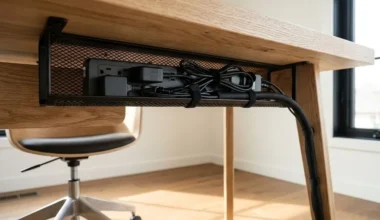
First, maintain visual lightness by preserving negative space. Resist the urge to fill every square inch of your desktop with gadgets or decorative items; bare wood surface is itself a restorative visual rest for tired eyes. Second, establish consistent material dialogue throughout the room. If your desk features white oak, echo that pale grain in picture frames, floating bookshelves, or flooring trims. Third, hide technical friction completely: ensure that all power distribution, charging cables, and peripheral transformers remain entirely invisible from normal standing and seated sightlines.
Cultivating Enduring Harmony in Intentional Workspaces
Creating an inspiring Scandinavian workspace is not a fleeting weekend project or an exercise in surface styling. It represents a deeper architectural dialogue between physical form, natural textures, and the mental rhythms of daily work. When you eliminate chaotic cable nests and replace synthetic surfaces with honest, living timber, the entire emotional resonance of the room transforms.
Each morning becomes an opportunity to step into an environment specifically engineered to protect mental clarity and nurture deep creative immersion. By investing care into fine details – from tactile wood grains and recessed cable trays to balanced 2700K ambient illumination – you build an enduring sanctuary that honors both personal wellbeing and professional craft.
Frequently Asked Questions
Which solid wood species is most durable for daily computer work?
European white oak offers an exceptional Janka hardness rating of 1,360 pounds-force, resisting pen indentations and daily mechanical friction better than softer alternatives.
Why is matte hardwax oil preferred over polyurethane for Scandinavian desks?
Hardwax oil penetrates into the cellulose fibers of the wood, preserving the natural tactile warmth without creating a synthetic, plasticky reflection under desk lighting.
How thick should a solid timber desktop be to avoid sagging?
A thickness between 1.25 and 1.75 inches provides structural rigidity across span widths up to 72 inches without requiring intermediate metal stiffening channels.
How often should a natural wood desk surface receive maintenance oiling?
Applying a thin coat of maintenance oil once every twelve to eighteen months refreshes moisture barriers and buffs away superficial micro-scratches.