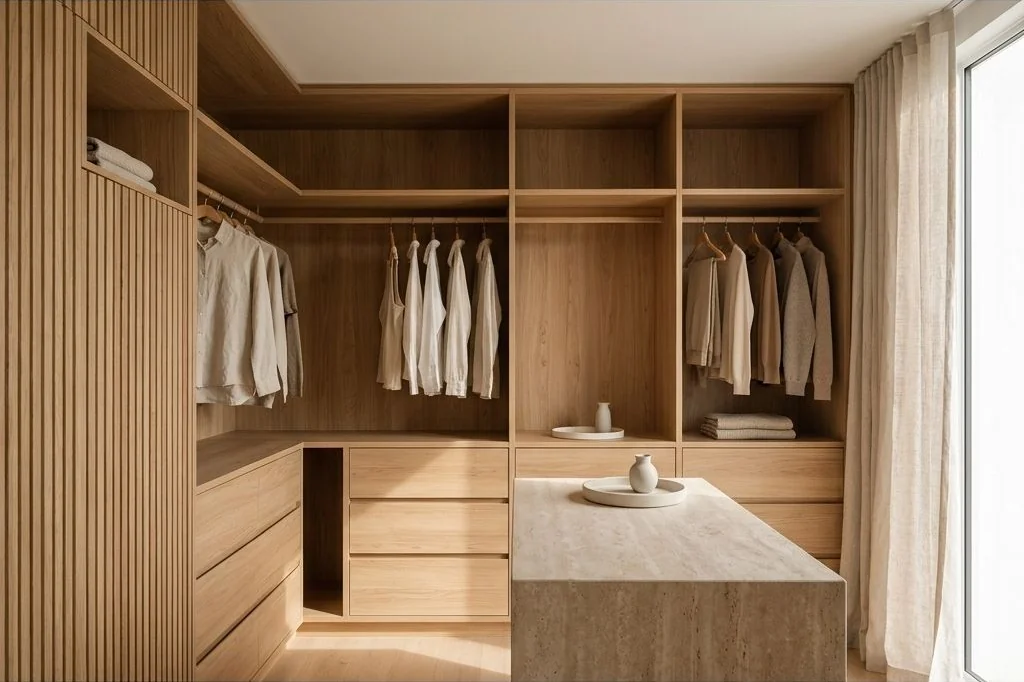
Opening your wardrobe in the morning should be an experience of grounded composure rather than visual friction. When clothing cascades off crowded rails, sweaters lean precariously across open shelves, and shoes form chaotic piles on the floor, the resulting sensory overload drains cognitive energy before your workday even begins. Traditional storage advice often treats closets as mere holding pens for excess possessions, relying on temporary plastic bins that obscure rather than solve spatial disorganization.
True closet organization architecture approaches the wardrobe as an intentional dressing sanctuary. By applying foundational spatial planning, calibrated vertical clearances, and high-performance organizing hardware, you convert arbitrary storage space into a high-functioning architectural asset. When every garment possesses dedicated breathing room and physical boundaries, maintaining visual equilibrium becomes effortless.
Key Takeaways
- Calibrated vertical zoning divides wardrobe storage into active eye-level rails, archival upper bins, and lower footwear platforms.
- Uniform slim velvet hangers eliminate visual turbulence and double hanging rail capacity without stressing delicate fabrics.
- Clear acrylic shelf dividers establish rigid boundaries that prevent stacked knitwear from collapsing laterally.
- Tiered footwear risers and vertical boot shapers protect floor clearances while providing full visibility for every pair.
- Integrated 2700K linear LED channel lighting delivers high-CRI color accuracy that reveals true garment tones without harsh glare.
Zonal Spatial Planning: Vertical Clearances and Ergonomic Reach
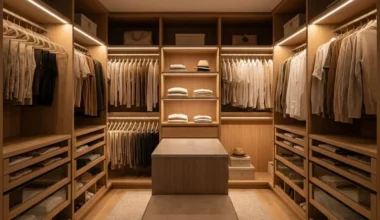
An enduring wardrobe design begins with strict dimensional zoning based on human ergonomics. Standard clothing wardrobes frequently fail because developers install a single generic hanging rail at eye level, squandering the upper forty percent of vertical volume while forcing longer garments to crumple against baseboards. Dividing your wardrobe into three vertical tiers restores natural flow.
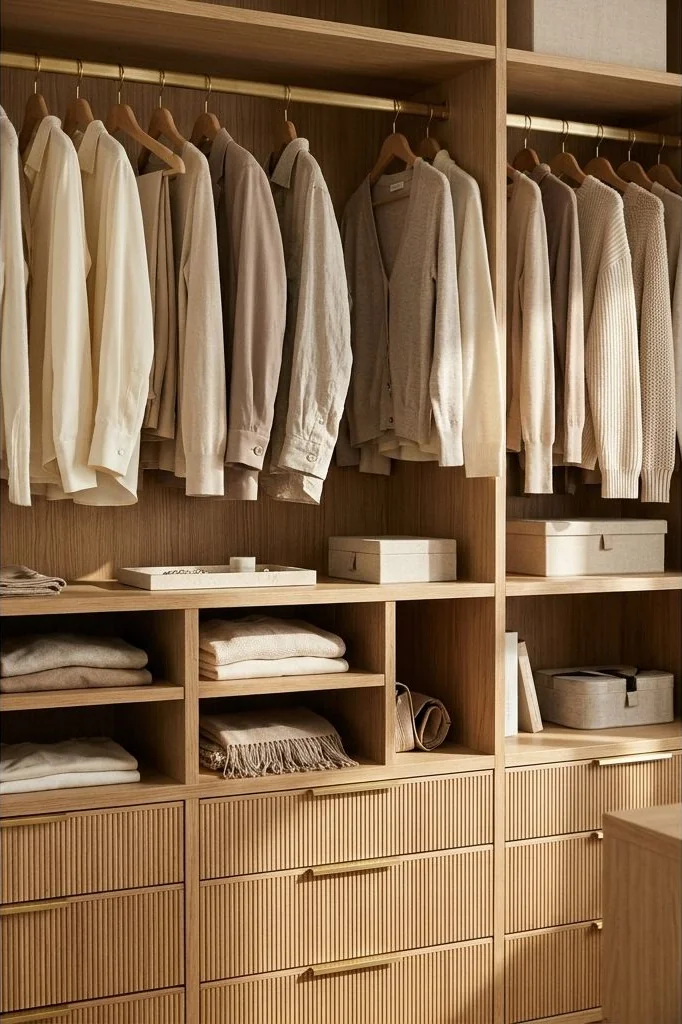
The primary active zone sits between waist height and eye level (roughly thirty-two to sixty-six inches from the floor). This prime real estate belongs exclusively to daily essentials: button-down shirts, tailored trousers, day dresses, and knitwear. Vertical clearances here must be rigorously respected. Tops and folded trousers require thirty-eight to forty inches of vertical hang space, while knee-length coats require fifty-two inches, and full-length winter overcoats demand sixty-five inches of unobstructed drop.
Secondary zones above eye level are designated for archival storage, seasonal woolens, and spare bed linens housed inside uniform fabric containers. The lower tier below thirty inches should integrate shallow pull-out drawers or structured shoe platforms to keep floor perches completely free of static clutter. For broader spatial perspectives on minimal interiors, consult our foundational framework on minimalist closet spatial organization.
The Uniform Hanger Mandate: Eliminating Visual Clutter
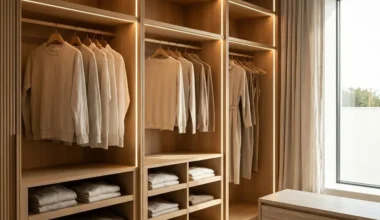
Nothing disrupts the architectural line of a closet faster than mismatched hangers. A chaotic patchwork of dry-cleaner wire frames, bulky plastic curves, and varied wooden contours creates visual turbulence that distracts the eye. Furthermore, wire hangers bend under the weight of natural wools, creating permanent puckers at garment shoulder seams.
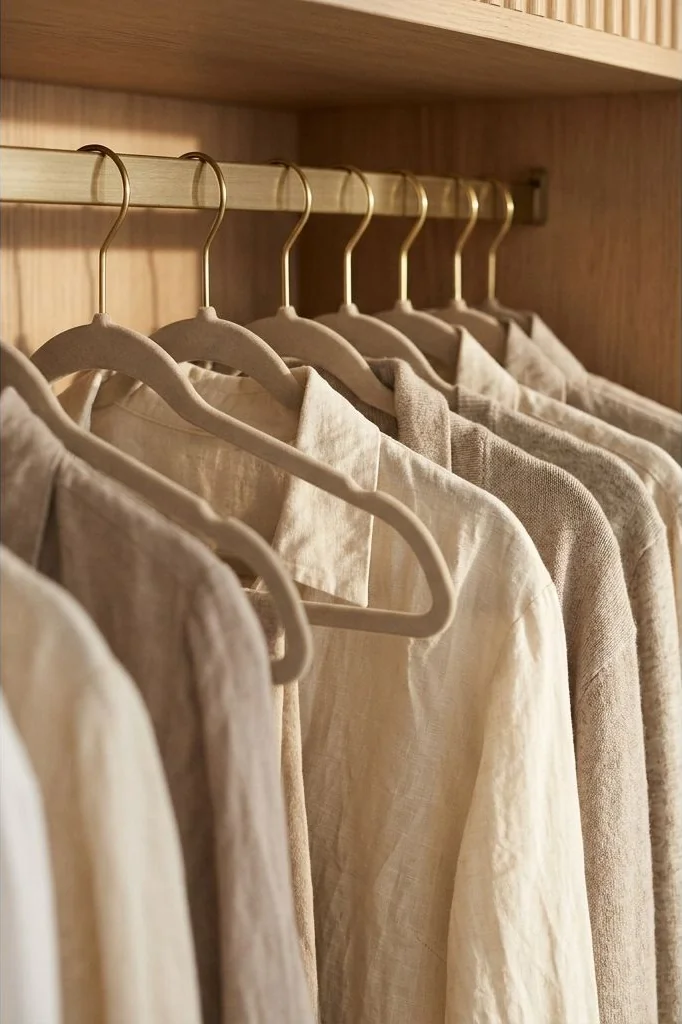
Implementing a strict uniform hanger standard transforms the aesthetic cadence of the entire dressing space. Ultra-slim velvet hangers in neutral tones like oatmeal or warm taupe provide immediate spatial and functional dividends. Their non-slip flocked texture prevents silk blouses and wide-neck tees from sliding to the floor, while their five-millimeter profile doubles hanging capacity along the rail without crowding garments.
When all hanger hooks share identical drop lengths and hardware finishes – such as brushed brass or matte nickel – garment collars align into a serene, continuous horizon. This visual rhythm allows you to focus on fabric weights, textures, and outfit formulas rather than navigating mechanical tangles.
Shelf Division Engineering: Acrylic Boundaries for Stacked Linens
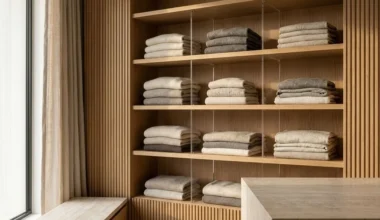
Open wardrobe shelving provides generous storage volume, but without physical boundaries, folded clothing inevitably experiences structural collapse. Sweaters stacked four or five high naturally tilt sideways under gravity, creating a messy slope that discourages taking items from the bottom of the stack.
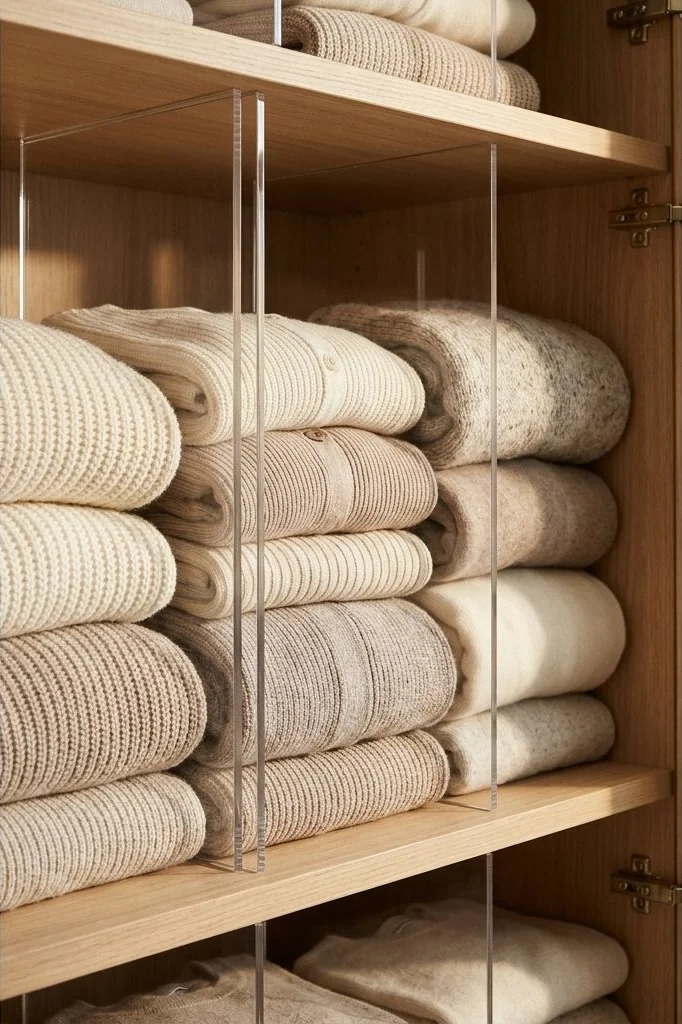
Installing heavy-gauge clear cast acrylic shelf dividers provides the vertical support required to keep stacks pristine. Unlike opaque wooden partitions that visually shrink the shelf, transparent acrylic offers structural rigidity while disappearing into the background. Bay widths between dividers should be calibrated between eleven and fourteen inches, matching the exact folded width of adult knitwear.
This division prevents stacked items from bleeding into neighboring piles, allowing you to slide a cashmere sweater out smoothly without disturbing adjacent garments. For additional guidance on seasonal wardrobe fabrics, explore our comprehensive study on capsule wardrobe fabric quality and natural fibers.
Tiered Footwear Storage: Protecting Floor Clearances
Footwear represents one of the most awkward categories in residential closet design due to varying heights, heel widths, and seasonal bulk. Leaving shoes loosely scattered across the wardrobe floor instantly destroys spatial intentionality, collecting dust and making baseboard cleaning a frustrating chore.
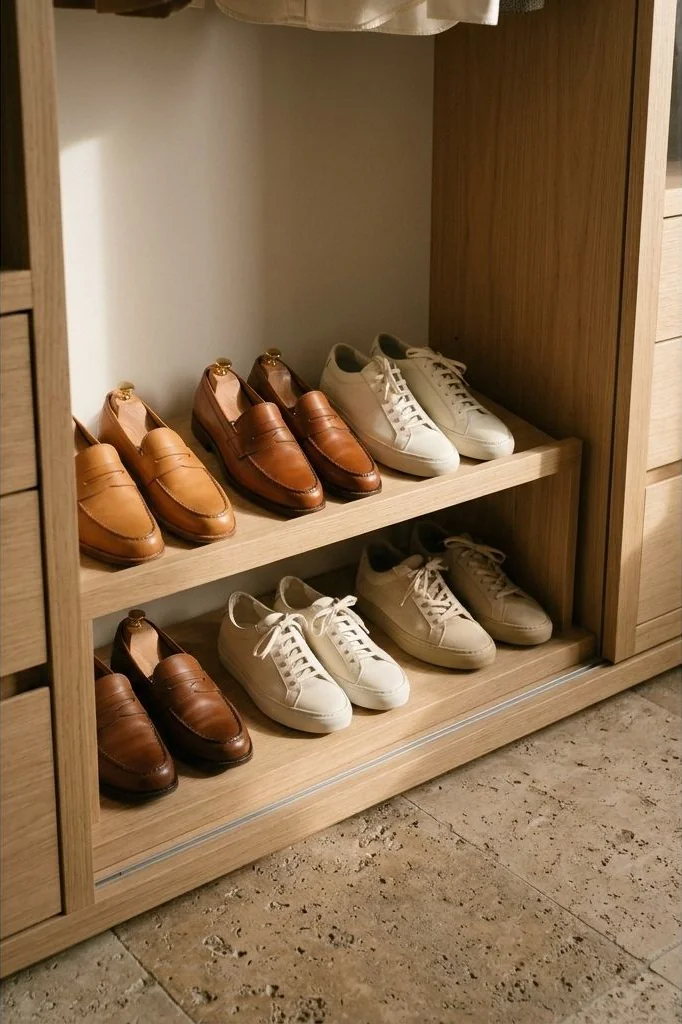
Tiered shoe risers engineered from solid oak or powder-coated steel double the storage density of any given footprint. By staggering pairs vertically – placing one shoe slightly raised and offset behind its mate – you reduce the horizontal width required per pair from ten inches down to six inches while maintaining full visibility.
For boot curation, vertical cedar shapers or inverted clear acrylic towers keep leather shafts upright, preventing unsightly creases and preserving structural leather integrity across months of non-use. To learn more about curating an intentional year-round footwear rotation, review our guide on the modular shoe capsule for year-round versatility.
Accessory Drawer Compartmentalization: Micro-Order
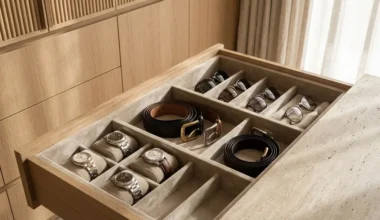
Deep drawers are the natural enemies of small accessories. When watches, leather belts, sunglasses, and pocket knives are deposited into a deep drawer, they inevitably settle into an untangled mass at the rear. Effective closet architecture utilizes shallow, four-inch-deep drawer formats fitted with velvet-lined organizing grids.
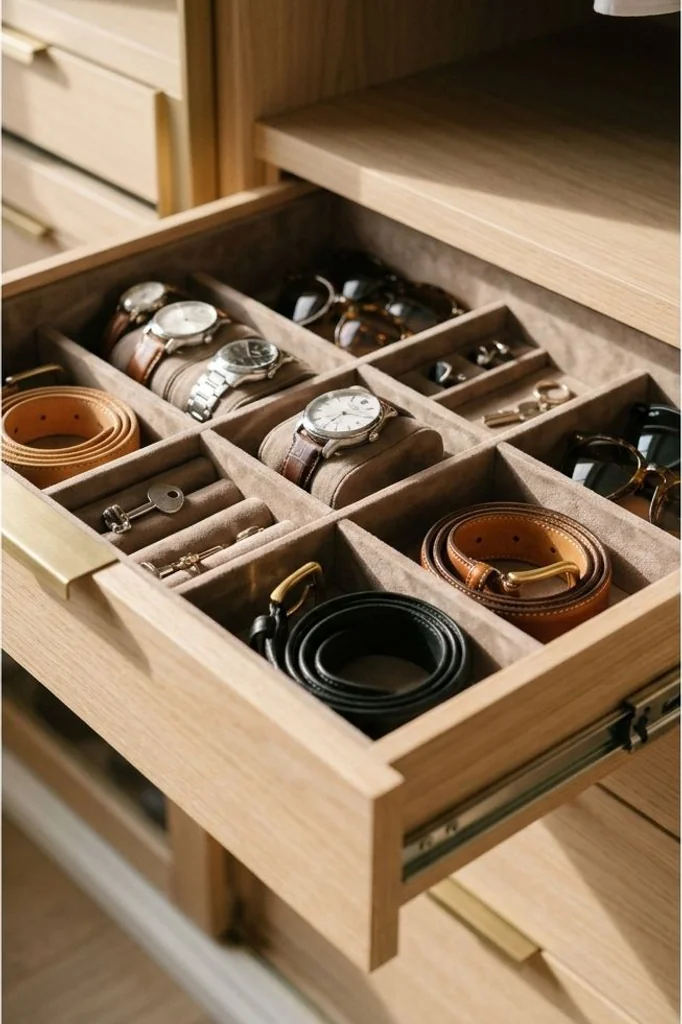
Micro-suede compartments cushion delicate hardware, preventing metal buckles from scuffing watch crystals or scratching precious metals. Rolling belts into tight spirals rather than hanging them from bulky wall hooks keeps closet walls pristine and preserves leather suppleness.
By giving every daily accessory a dedicated tactile slot, your evening return routine becomes second nature. Removing watches and jewelry into specific velvet grooves eliminates surface clutter across bedroom nightstands and bathroom vanities.
Integrated Illumination: 2700K Architectural LED Channels
Even the most meticulously organized wardrobe will feel oppressive if lit by a harsh, central ceiling bulb that casts unflattering downward shadows. High-performance wardrobe architecture incorporates diffused linear LED channels directly into the millwork reveals, casting uniform wash along the face of hung garments.
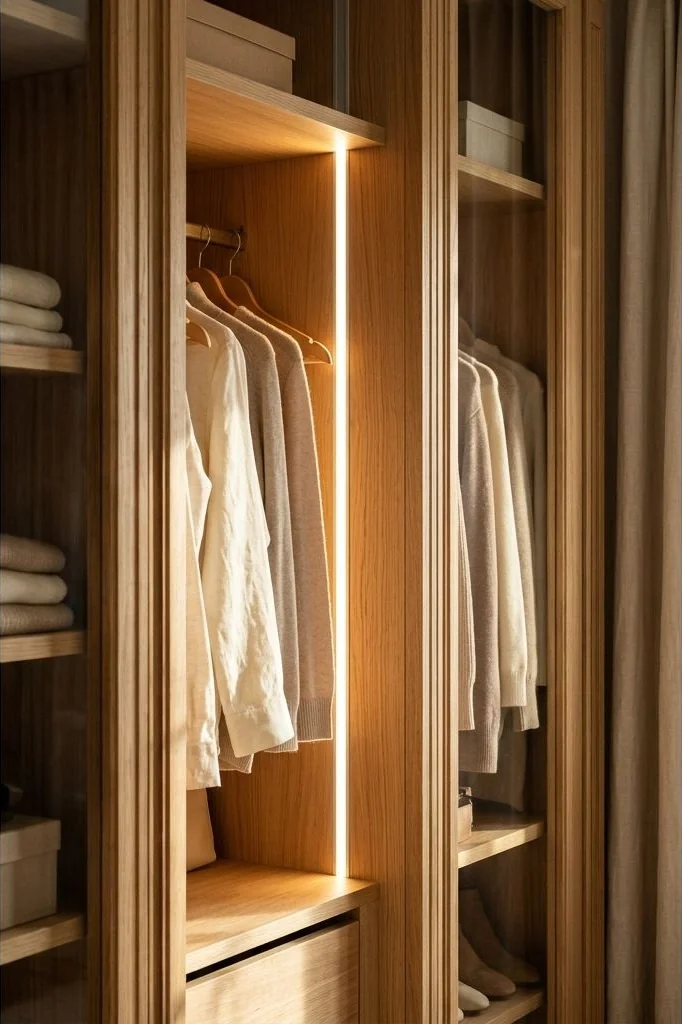
Lighting specifications must be strictly calibrated. A color temperature of 2700K provides a warm, inviting residential glow that feels soothing during early mornings. Crucially, specify an LED strip with a Color Rendering Index (CRI) greater than 95. High CRI illumination is essential for distinguishing between subtle dark tones, ensuring you never mistake deep navy trousers for charcoal black in dim morning light. Explore further residential lighting principles in our guide on smart lighting color temperature and circadian wellness.
As highlighted in editorial features by Architectural Digest, integrating concealed linear lighting transforms utilitarian storage into a luxurious spatial feature that enriches the daily routine. Discover our full catalog of architectural prints and living inspiration at ornista.com.
Frequently Asked Questions
How much hanging space should be allocated per garment on a wardrobe rail?
Allow approximately one and a half to two inches of horizontal rail width per garment when using slim velvet hangers. This spacing provides adequate air circulation between fabrics, prevents compression wrinkles, and allows you to browse the rail smoothly without snagging neighboring pieces.
Are acrylic shelf dividers compatible with standard wire closet shelving?
Standard clip-on acrylic dividers require a solid wood, plywood, or laminate shelf surface with a thickness between three-quarters of an inch and one inch. For wire closet shelving, overlay a custom-cut thin sheet of acrylic or natural wood veneer over the wire slats before sliding dividers into place.
What is the most effective way to store heavy seasonal winter knitwear?
Heavy winter knitwear should never be hung on hangers, as the weight of the wool will stretch the neckline and shoulder seams out of shape. Fold knits carefully and store them flat on open shelves between acrylic dividers, or place them inside breathable linen storage bins on upper closet shelves.